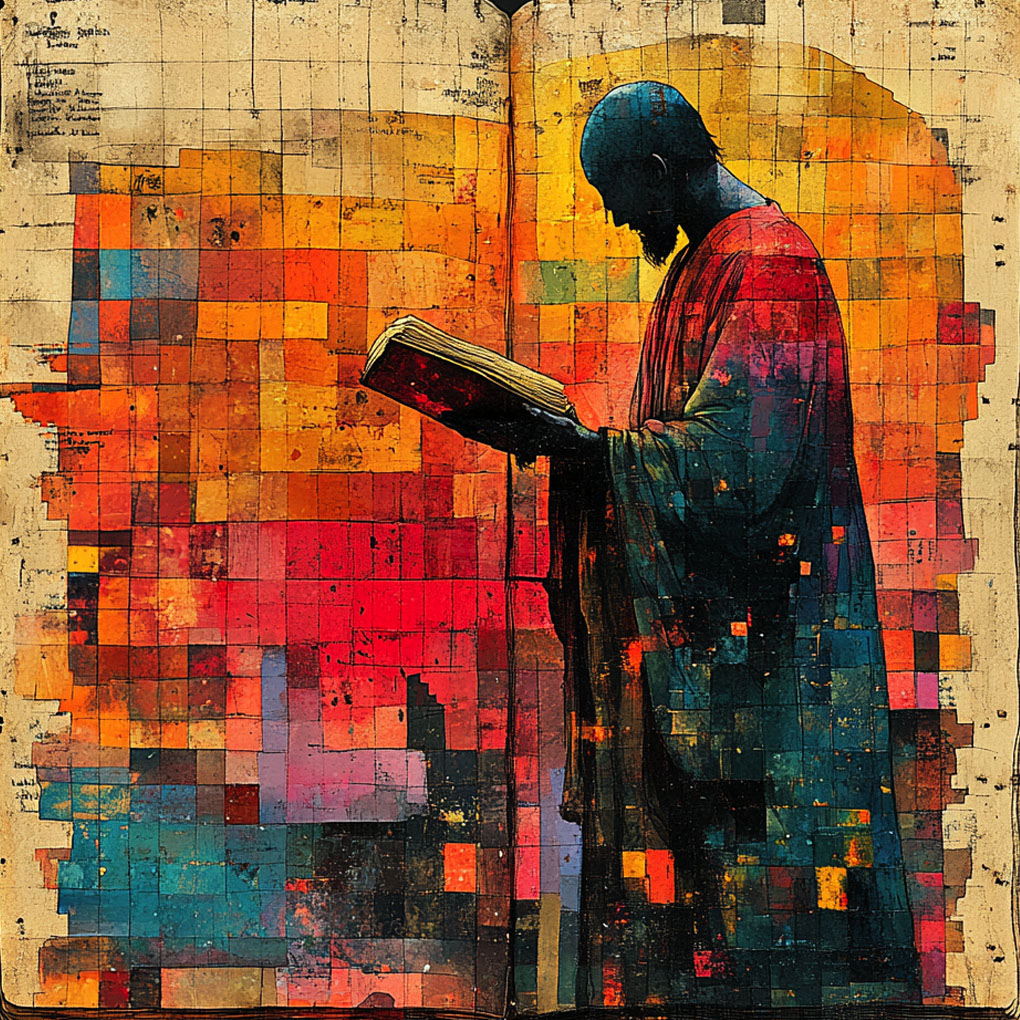
Rescued from a monastery wastebasket bound for the fire, this fourth-century manuscript turned out to be the oldest complete New Testament on earth.
Did you know? 🤔 The Codex Sinaiticus, one of the oldest known Bible manuscripts, was discovered in pieces between 1844 and 1859 at St. Catherine’s Monastery in Egypt. It dates back to the 4th century and is the oldest complete copy of the New Testament. Interestingly, it includes two books not found in modern Bibles: the Shepherd of Hermas and the Epistle of Barnabas.
In 1844, a young German scholar named Constantin von Tischendorf arrived by camel at St. Catherine’s Monastery, a remote Christian outpost tucked at the foot of Mount Sinai in the Egyptian desert. There, in a wastebasket destined for the fire, he spotted torn parchment leaves covered in ancient Greek script — fragments of the Old Testament, older than anything he had ever seen. It was the first glimpse of what would become one of the most significant biblical manuscripts ever found: the Codex Sinaiticus.
Tischendorf returned to the monastery twice more, in 1853 and again in 1859, convinced there was more to be found. On his final visit, the monastery’s steward showed him a large volume wrapped in red cloth, kept in his own quarters. Inside were the fragments Tischendorf had seen fifteen years earlier, along with far more: substantial portions of the Old Testament, and — remarkably — the entire New Testament, complete, the oldest complete copy that exists anywhere in the world. Dated to the middle of the fourth century, the Codex Sinaiticus had likely been produced only a few decades after Christianity’s legalization under Constantine, at a time when the exact boundaries of the New Testament canon were still being settled across the church.
That last detail is part of what makes the manuscript so fascinating today. Alongside the books now familiar to every modern Bible, the scribes who copied Codex Sinaiticus included two additional texts they evidently considered worth preserving alongside Scripture: the Epistle of Barnabas, a letter reinterpreting the Jewish Scriptures in light of Christ, and the Shepherd of Hermas, a lengthy work of visions and moral instruction. Neither ultimately made it into the New Testament as the canon was finalized in the centuries that followed, but their presence here is a valuable window into how fluid and actively discussed those boundaries still were in the fourth century, even as the core of the New Testament we know today had already taken firm shape.
The manuscript’s more recent history has been almost as eventful as its ancient one. Tischendorf carried it back to Russia, where it remained for decades until the Soviet government, in need of funds rather than manuscripts, sold it to the British Museum in 1933 for £100,000 — a sum equivalent to millions today. Portions of the codex are now held across four different institutions worldwide, including a few leaves the monks themselves discovered still hidden at St. Catherine’s as recently as 1975. In 2005, those scattered collections were finally digitized and united online, so that anyone, anywhere, can now examine page by page a manuscript that survived seventeen centuries, a desert monastery, an empire’s collapse, and one scholar’s persistence — carrying the New Testament, whole and intact, across all that distance to reach us.
Did You Know?


